

Canada’s 2026 Tarot Reading - Part I: A retrospective
Unveiling the Energies
We did it. We survived 2025. What a year! Let’s be honest: since 2020, it feels like the screenwriters of Earth have been crafting an impressively dramatic saga. Each new season comes with more intensity and more formidable “villains” than ever before. Just when we think the plot is resolved, a surprise twist sends us in a completely new direction. This roller coaster hasn’t been great for our physical or mental health, so a little preparation and readiness are welcome.
Last year, I did a reading at the end of the year, just before Trudeau announced his step down. In my reading, I saw that he would resign, but that Pierre Poilievre would face significant challenges in attaining the position he desired. The 4 of Cups was his central card. In the traditional Rider-Waite Tarot, it represents contemplation. In The Pulp Tarot, it reads: “Soon the journeyer reaches a point of celebration; depression sets in.” This could not describe the feelings around Poilievre more accurately.
He was ecstatic when the election call came while he was polling high, yet Canadians were frustrated with economic hardship, high unemployment, and rising interest rates. Then, in a shocking twist reminiscent of Trump’s “win” in the U.S., everything took an unpredictable turn. Truthfully, Canadians were frustrated with all party leaders: Trudeau for the deficit and stalling economy, Poilievre for his aggressive rhetoric, and Singh as the “mirror Poilievre” on the left.
When Trudeau stepped down, the usual target for criticism disappeared, creating a rhetorical void, leaving space for Mark Carney to rise and manage the chaos.
This year, I’ve decided to share my reading for 2026. It doesn’t feel right to keep these insights or the gossip of the cards to myself. The Pulp Tarot is quite the storyteller and truly enjoys public political readings. It’s not my go-to for personal readings, though; I usually reach for another deck when reading for myself or for others.
Without further delay, here is my Celtic Cross spread. The question I asked was: “What are the energies for Canada in 2026?” Let’s see what messages the cards have to offer.
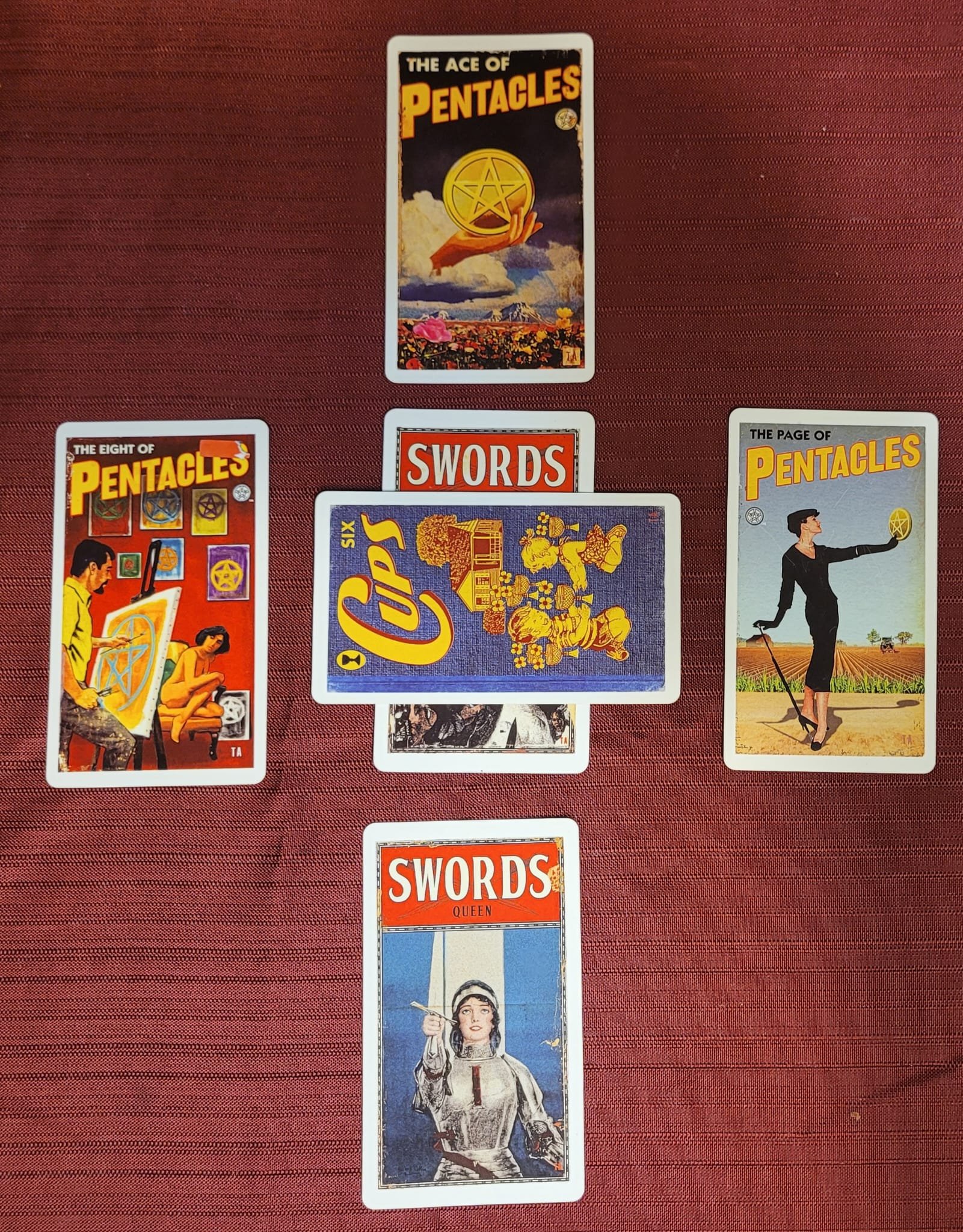
Half of Celtic Cross reading for Canada’s energies in 2026.
Card 1: The influences surrounding the question - Knight of Swords
We are stepping into a year charged with bold, decisive, and intellectually vibrant energy. The cosmos itself seems to echo this intensity — in 2026, multiple planets align in fiery Aries. Numerology amplifies this force, as 2026 carries the energy of the number 1, signaling leadership, initiative, and new beginnings. Meanwhile, according to the Chinese horoscope, it is the Year of the Fire Horse, a symbol of courage, drive, and unstoppable momentum. All of this points to a year defined by action, ambition, and focused energy.
Our Prime Minister embodies this dynamic perfectly, leading with determination and ambitious goals. The Tarot reflects this momentum: he is on a mission, ready to take decisive action and navigate challenges strategically. Ideas will be seized, obstacles confronted, and progress pursued with unwavering focus.
Despite facing attacks and betrayal, there is a sense of growing cohesion that encourages us not to be intimidated. The year ahead calls for strategy, courage, and precision. This energy mirrors the current image of our leadership and captures how we are maneuvering through economic pressures and the complexities of international politics.
Card 2: Forces for good or evil - Six of cups
The 6 of Cups depicts a boy offering a cup to a girl in a lush garden, surrounded by flowers, with a warm and familiar home in the background. It is a card deeply rooted in nostalgia, evoking childhood memories, innocence, and emotional bonds from the past. When this card appears, it gently invites reflection, asking us to revisit earlier experiences and relationships, not to live in them, but to reclaim the joy and wisdom they once offered.
On a broader, collective level, the 6 of Cups speaks to how things used to be. It symbolizes integration, collaboration, and a sense of mutual trust. Appearing in the position of “forces for good or evil,” this card mirrors the emotional landscape of many Canadians right now. Nostalgia, after all, can be both comforting and dangerous. It can help us recognize what worked and what mattered, but it can also trap us in longing for a past that no longer exists. Here, it reflects a sense of lost trust, a once-trusted ally or friend who suddenly shifted direction in ways that challenged core values.
The message of the 6 of Cups is clear: the past cannot be restored exactly as it was. It is a memory, not a destination. While it inspires reflection and even grief, it also encourages growth. The lesson is to carry forward the spirit of cooperation and goodwill, without trying to recreate an outdated reality. By honoring what was while remaining grounded in the present, we can move forward with clarity, using the lessons of the past to consciously shape the future.
Card 3: The past - Queen of swords
The Queen of Swords can be seen as embodying Justin Trudeau’s energy. At first, I wasn’t entirely sure why his name popped into my mind when this card was revealed, but then the connection became clear. In this deck, the Queen is represented by Joan of Arc, a fitting choice considering Trudeau’s French heritage. Joan exudes confidence, determination, and unwavering belief in her mission. She is highly motivated, sure of herself, and decisive in every action she takes. This card embodies intellect, clarity, independence and reflects Trudeau’s leadership style. A mix of intellect and a feminine energy seamlessly integrated into his role.
However, this very energy also made him polarizing. By the end of his term, Trudeau faced intense criticism, in part because the reflective nature of the Queen of Swords held up a mirror to the patriarchal shadow. His leadership challenged old structures and exposed contradictions, and not everyone was comfortable with the introspection it provoked. In a world where the extreme right and a resurgence of patriarchal forces often demand the removal of allies, his embrace of vulnerability, compassion, and emotional intelligence became both a strength and a lightning rod.
What I found most fascinating about Trudeau’s exit is how he orchestrated it strategically. He stepped back at precisely the right moment, allowing Mark Carney to emerge as his successor, ensuring continuity for the Liberal Party and its leadership. Behind the scenes, his careful planning and vision helped Canada avoid being dismantled under external pressures. You may question his decisions or his politics, but there is no denying the strategy, foresight, and resilience embedded in his leadership.
Card 4: Something just going away - 8 of pentacles
The 8 of Pentacles is the card of hard work, dedication, and the slow mastery of a craft. In this deck, it speaks even more clearly about learning a new trade, developing new skills, and searching for one’s place in the world. But it also carries the weight of loss and rebuilding. Something is ending, and something new is being shaped, piece by piece.
For many Canadians, this card reflects a very real experience. Jobs were lost, trades disrupted, and long-standing livelihoods shaken by tariff wars and sudden executive orders from across the border. The instability and rapid policy shifts left people feeling attacked, exposed, and vulnerable. Overnight, agreements that once felt solid were dismantled, and the sense of economic security many relied on began to erode.
The 8 of Pentacles reminds us that rebuilding often begins at the most basic level. Individually, countless Canadians were forced to adapt, retrain, and rethink their paths after losing jobs with little warning. Collectively, the same process is unfolding on a national scale. Canada is turning outward, bringing its products, minerals, and energy to the global stage, redefining where and how its value is shared.
The partnership with the United States, as we once knew it, is no longer guaranteed. Now, we are in a period of recalibration, sorting through what we have, what we know, and what we can offer. The 8 of Pentacles doesn’t promise ease, but it does promise progress through commitment. It reminds us that through patience, skill, and perseverance, a new foundation can be built, stronger and more intentional than before.
Card 5: This may happen - Ace of Pentacles
The Ace of Pentacles in the “this can happen” position points to a very grounded possibility for Canada. It suggests that amid uncertainty, a real and tangible opportunity can emerge, not through spectacle or ideology, but through practical action. This is the kind of future that unfolds quietly: new economic pathways, renewed investment in resources, and steady rebuilding rather than dramatic rescue. If choices remain intentional and long-term focused, stability is not just hopeful thinking, it becomes achievable.
This card is not a promise, but an invitation. It reminds us that potential only becomes reality when it is nurtured. Canada stands at a threshold where patience, strategy, and care can transform disruption into something lasting. The opportunity is on the table; what happens next depends on how wisely it is handled, but also reflects Canada’s shift toward rebuilding stability on its own terms.
As old economic partnerships falter, the focus turns inward and outward at the same time, toward our resources, skills, and global potential beyond familiar dependencies. What’s being planted now will shape the future. This card reminds us that slow, intentional choices matter, and that sustainable growth comes from patience, commitment, and a willingness to build something new from the ground up.
This first part of the reading lays the groundwork. It traces where we have been, what has unraveled, and how Canada is currently orienting itself amid uncertainty. The cards speak of decisive leadership, unresolved nostalgia, the closing of an era, and the slow, necessary work of rebuilding. Together, they paint a picture of a country in transition, no longer able to rely on old structures, yet not quite finished shaping the new ones.
What emerges most clearly is this: Canada is standing at a threshold. The past still echoes loudly, the present demands courage and precision, and the future is being quietly planted through deliberate choices. Part I is not about conclusions, but about awareness. It asks us to recognize the forces at play, the losses we must acknowledge, and the opportunities that are beginning to take root beneath the surface.
In Part II, the reading moves forward. We will explore what lies ahead, the fears and doubts that may arise, the role of allies and community, the hopes shaping our collective vision, and ultimately, the outcome of this unfolding story. If this first chapter was about understanding the terrain, the next is about navigating it.
Stay tuned for Part II. I can’t wait to share the next chapter with you. The next cards have much more to say.
If you enjoyed what you’ve read so far, you can schedule a session with me here.
If you’re curious and want to learn more about my work, you can find out more here.
And if you’re looking for cosmetic detox with natural products, you can explore that here.